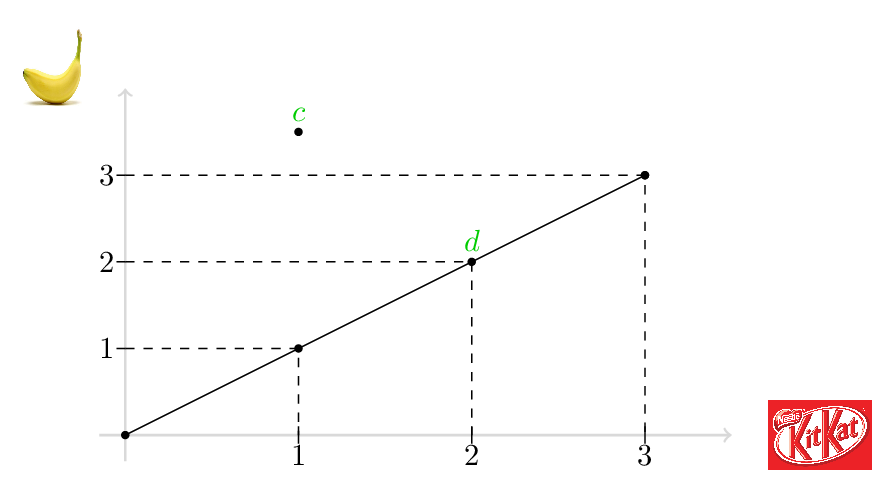
- For any basket in the diagonal $(x,x)$ its utility is equal to $u(x,x)=x$.
- For any other basket $c$, find a basket in the diagonal $d$ such that $c\sim d$ and set $u(c)=u(d)$.
Consider a set $X$ of alternatives. Think primarily of $X$ as the set of possible baskets of consumption goods/services, $x=(x_1,x_2,\dots,x_n)$ in $X$ is a basket that contains $x_1$ units of good 1, $x_2$ units of good 2, ..., $x_n$ units of good $n$.
The standard model assumes that any individual is able to compare and rank the elements of $X$. Fix some individual $i$.
We write $\mathbf{x} \succeq_i \mathbf{y}$ to say that individual $i$ considers the basket $\mathbf{x}$ at least as good as basket $\mathbf{y}$.
And $\mathbf{x} \succ_i \mathbf{y}$ means that individual $i$ considers the basket $\mathbf{x}$ strictly better than the basket $\mathbf{y}$.
We call the ranking $\succ_i$ individual $i$'s preferences.
Given a choice set $X$ and individual $i$ with preferences $\succeq$ we shall assume:
We want to test whether a consumer's choices are rational. So we consider a sequence of prices and choices $(\mathbf{p}^t, \mathbf{x}^t)$, $t=1,\ldots,T$ that the consumer made over time.
Notice that $\mathbf{p}^t$ is a list of prices prevailing at time $t$. For example, in the case of two goods, X and Y: $\mathbf{p}^t=(p^t_{x},p^t_{y})$ and $\mathbf{x}^t=(x^{t},y^{t})$ is the basket chosen by the consumer at period $t$.
To save notation, we write $\mathbf{p}^t\cdot \mathbf{x}^t$ for the value of the basket under the prices, so $\mathbf{p}^t\cdot \mathbf{x}^t=p^t_{x}x^{t}+p^t_{y}y^{t}$.
Consider a sequence of prices and choices $(\mathbf{p}^t, \mathbf{x}^t)$, $t=1,\ldots,T$.
Consider a sequence of prices and choices $(\mathbf{p}^t, \mathbf{x}^t)$, $t=1,\ldots,T$.
If $\mathbf{x} \succeq_{DR} \mathbf{y}$ or $\mathbf{x} \succeq_{IR} \mathbf{y}$ we say that $\mathbf{x}$ is revealed to be preferred to $\mathbf{y}$ and write $\mathbf{x} \succeq_R \mathbf{y}$.
Main results:
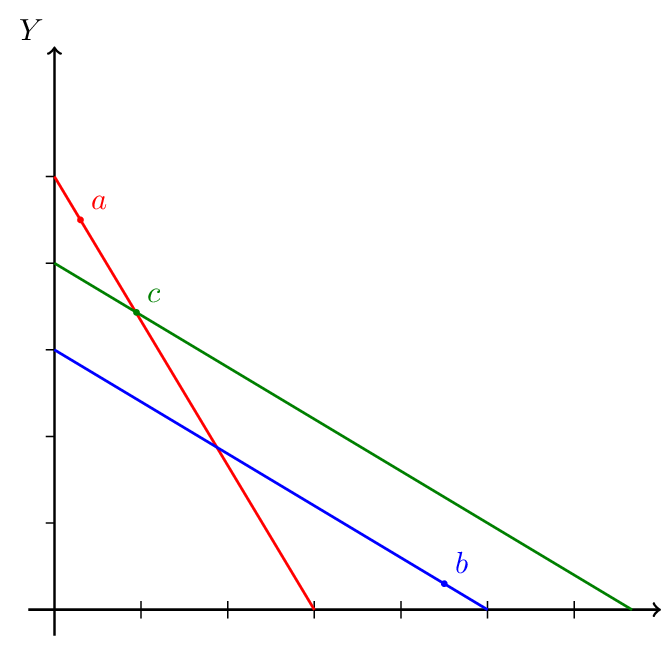
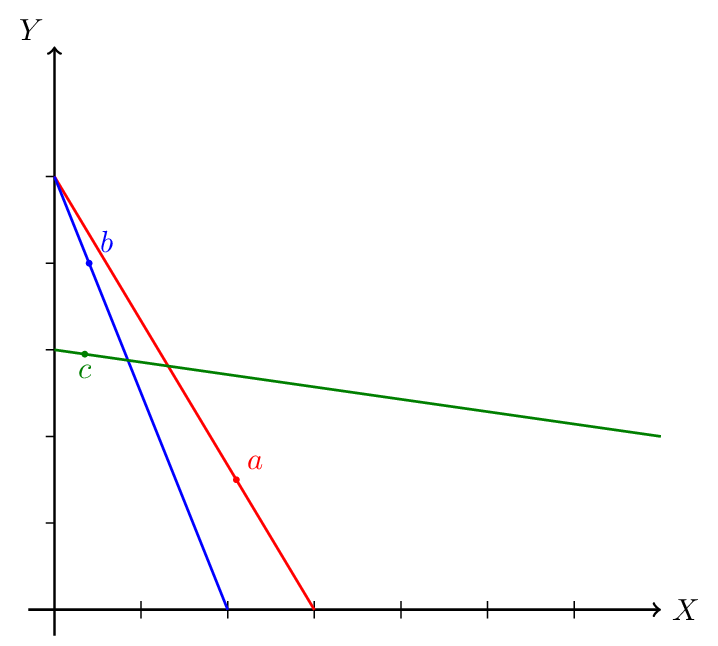
In this other example, GARP is violated. Can you explain why?
Assume two goods (X and Y) for simplicity and imagine that instead of maximizing some utility, the consumer chooses her optimal basket according to one of the behavioral rules below — we are assuming our consumer follows just one of the rules. We cannot dismiss the consumer as being irrational because perhaps the behavioral rule can be generated by rational preferences.