Consider the market for college education in the United States. College degrees have become quite expensive in the U.S., but around 1 million people in the U.S. earn a degree each year. Suppose the yearly supply and demand functions for degrees in the U.S. are:
\( S(p) = 20p \)
\( D(p) = 1,200,000 - 10p \)
- Using these supply and demand functions, find the equilibrium price and quantity in the private market for 4-year degrees.
- Suppose each person with a college degree creates an external benefit for society that can be valued at \(\$10,000\). Graph the private supply and demand curves, and label the equilibrium that you found in part a. Then, add to your graph the social demand curve for college degrees.
- Label the section of your graph showing the deadweight loss from the externality of a college degree. Is this DWL coming from over- or underproduction?
- If the government were to try to correct this market failure, would it be better to use a tax to do so, or a subsidy? What is the correct value for the tax or subsidy they should use?
- When taking the external benefits of the externality into account, the social demand function for college degrees is:
\( D(p) = 1,300,000 - 10p \)
Using this new demand curve, calculate the socially optimal price and quantity for a 4-year college degree. - If the government does not intervene in the market for college degrees, what is the dollar value of the deadweight loss in the private equilibrium?
(a) Equilibrium price and quantity in the private market
Set supply equal to demand:
\( 1,200,000 - 10p = 20p \)
\( 1,200,000 = 30p \)
\( p^* = \$40,000 \)
Substitute into the supply function:
\( Q^* = 20 \times 40,000 = 800,000 \)
(b) Graph of private and social demand curves
Each person with a college degree creates an external benefit valued at \(\$10,000\). The social demand curve is shifted rightward by this external benefit.
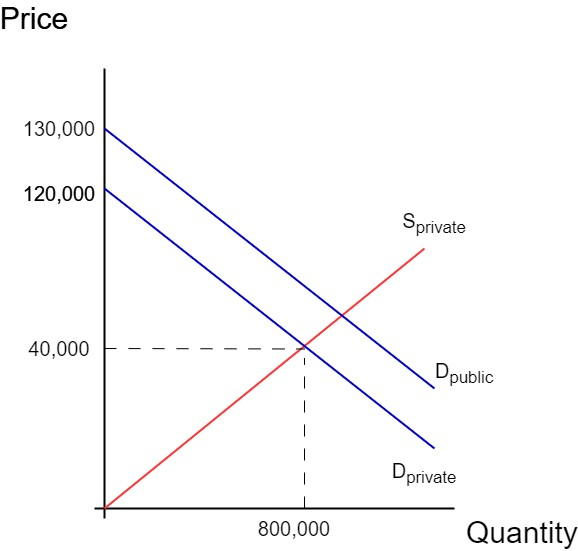
(c) Deadweight loss and underproduction
DWL is present in the triangle bounded on the left by the quantity of 800,000, on top by the social demand line, and on bottom by the private supply line. Here, the market is underproducing the good, as buyers of college degrees do not take into account the external benefit their education produces.
(d) Tax versus subsidy
With positive externalities, the government should use a subsidy to encourage consumption. The correct value for the subsidy is always exactly equal to the marginal external benefit: here, \(\$10,000\).
(e) Socially optimal price and quantity
Using the social demand function \( D(p) = 1,300,000 - 10p \), set it equal to supply:
\( 1,300,000 - 10p = 20p \)
\( 1,300,000 = 30p \)
\( p^* = \$43,333 \)
Substitute into the supply function:
\( Q^* = 20 \times 43,333 = 866,667 \)
(f) Dollar value of deadweight loss
The level of underproduction is \( 866,667 - 800,000 = 66,667 \) units. The "height" of the DWL triangle is equal to the marginal external benefit (\(\$10,000\)). Using the area of a triangle formula:
\( \text{DWL} = \frac{1}{2} \times 66,667 \times 10,000 = \$333,335,000 \)