← back to index

Recitation 5

Long Run Perfect Equilibrium

Concept: Profit Maximization

In perfect competition, profit is the rectangle \(q^*(p - AC(q^*))\) where the firm produces at the quantity where \(p = MR = MC\).
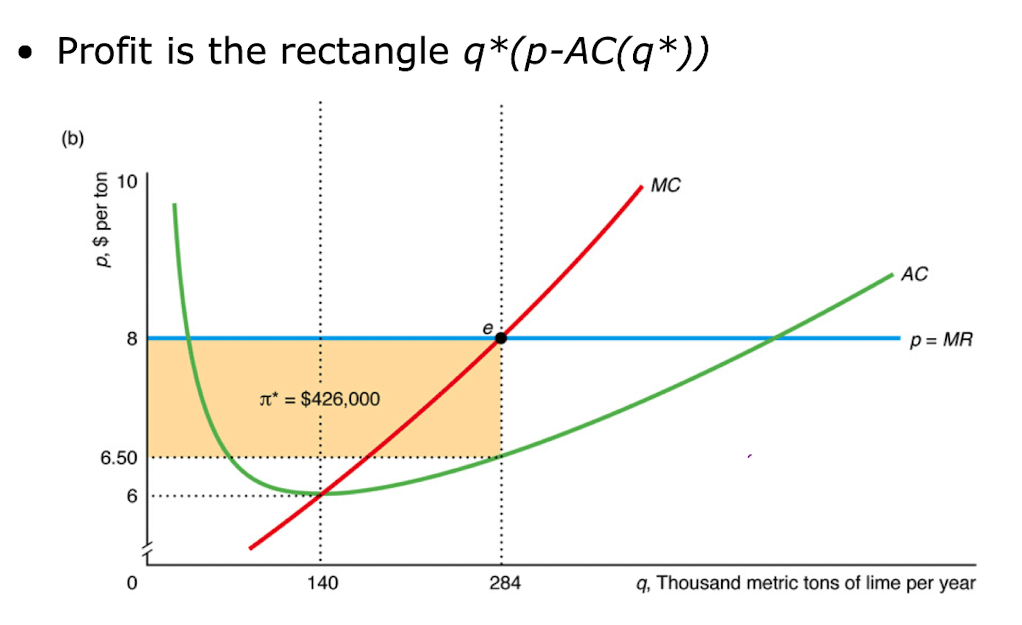
Profit maximization diagram showing MC, AC, and p=MR curves. The firm produces at quantity 284, where MC intersects the horizontal price line at $8 per unit. Average cost is $6.50, yielding profit of $426,000 (the shaded rectangle).
Figure: Profit as the rectangle \(q^*(p - AC(q^*))\). At equilibrium (point e), price equals $8, output is 284 thousand metric tons of lime per year, AC is $6.50, and profit is $426,000.

Problem 1: Short-Run vs. Long-Run Dynamics

A perfectly competitive firm is maximizing its profit in the short-run. At the profit-maximizing level of output, \(P < ATC\).

Compared to the short-run, in the long-run there will be _____ firms, and each firm will produce ________ quantity.

  1. more; a smaller
  2. more; a larger
  3. fewer; a smaller
  4. fewer; a larger
  5. fewer; the same

Problem 2: Market Equilibrium Analysis

There are 80 firms in a perfectly competitive market, each with the following total cost function:

\[TC(q) = 144 + 4q^2\]

Market demand is represented by:

\[Q_D = 1600 - 30P\]

  1. How much output will each firm produce in the short-run, and how much profit will it make?
  2. State what you expect will happen in the long-run to the number of firms, market price, individual quantity, and profit.
  3. Calculate each of the above at long-run equilibrium. Calculate CS and PS.